what happened to the spinning house after george washington died
Martha Dandridge Custis
By John Wollaston, 1757
Digital facsimile print and reproduction frame
John (Jacky) Parke Custis and Martha Parke Custis
By Charles Volkmar after John Wollaston, 1757
19th-century oil-on-canvas replica and reproduction frame
In 1757, Martha Dandridge Custis and her first husband Daniel Parke Custis commissioned a pair of portraits of themselves along with a smaller portrait of their ii immature children. They intended to hang these pictures at their abode at White Firm plantation, but earlier they were completed, disaster stuck: Daniel died on July viii, 1757. Nigh two years later, Martha brought these two portraits with her to Mount Vernon and she probable left the portrait of Daniel behind.
John Wollaston painted Martha in a fashionable dress with a background of heaven and trees. Her pose, setting, and dress attest to her gentility, while the orange branch in her hand symbolizes her fertility. The entire scene, with the exception of Martha'due south face, is almost certainly derived from an English impress source. Trained as a drapery painter in London, John Wollaston was one of the few itinerant portrait painters in the Mid-Atlantic in the mid-18th century. He traveled through Virginia in the 1750s and painted many of the Colony'south nigh prominent citizens.
Recreation: George and Martha Washington replaced the frames on the two big Wollaston portraits and the Charles Willson Peale quondam after 1795 when George wrote to his farm manager requesting the sizes of the paintings. Though the original frames practise not survive, George Washington'south probate inventory notes that they were "Gilt," and given the date of their purchase, they were likely made in the neoclassical style in Philadelphia. This upgrade refreshed older portraits and brought their decoration into alignment with many of the other changes in the room. This simple "American cove" mode frame with composition ornamentation leaves is a common Philadelphia model of the menses. It was made by P.H. Miller Studios of Berryville, Virginia. The original painting is owned by Washington and Lee Academy, and this photographic facsimile was made by One-time Town Editions of Alexandria.
Colonel George Washington

by Charles Willson Peale, 1772
Digital facsimile print and reproduction frame
Annapolis-born artist Charles Willson Peale visited Mount Vernon for 10 days in May 1772 and painted the first known portrait of George Washington to hang as a pendant to John Wollaston'southward before portrait of Martha Dandridge Custis.
For the portrait, Washington sported fashionable accessories that communicated his status equally a one-time military officeholder. He wears a silver gorget, engraved with the British regal coat of artillery, around his neck and a red military sash across his chest—both symbols of rank. At Washington's left side, the artist depicted the silverish hilt of his ornamental smallsword, made in London afterwards 1767. Washington's uniform displays the blue and red colors of the Virginia Regiment—the unit he commanded from 1755 to 1758, during the French and Indian State of war—just he has updated the coat's cut to an early 1770s style.
The portrait's setting evokes Washington's military service but does not represent a specific event or location. The tents at lower left signal a armed services encampment, while the waterfall and the vast forests and mountains ascent across suggest the mural of the Ohio River Valley.
Recreation: George and Martha Washington replaced the frames on the two big Wollaston portraits and the Charles Willson Peale sometime later 1795 when George wrote to his farm manager from requesting the sizes of the paintings. Though the original frames exercise not survive, George Washington's probate inventory notes that they were "Gold," and given the date of their buy, they were probable fabricated in the neoclassical style in Philadelphia. This upgrade refreshed older portraits and brought their ornamentation into alignment with many of the other changes in the room. This simple "American cove" style frame with composition ornament leaves is a common Philadelphia model of the period; it was made by P.H. Miller Studios of Berryville, Virginia. The original painting is endemic by Washington and Lee University, and this photographic facsimile was made by Former Town Editions of Alexandria. The original is on exhibition in the Donald W. Reynolds Museum and Education Center at Mount Vernon.
Frances (Fanny) Bassett Washington
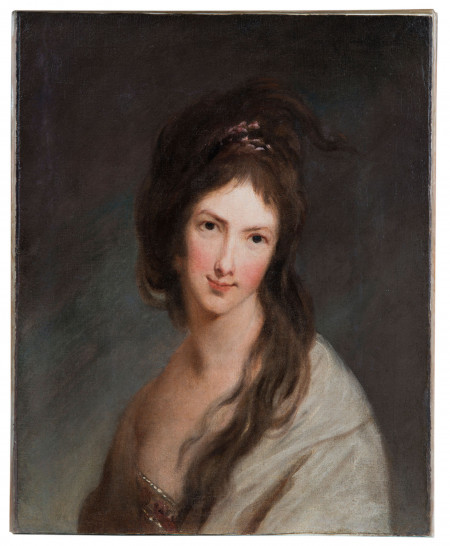
Gavin Ashworth
past Robert Edge Pine, 1785
Original oil-on-canvas and reproduction frame
In 1785, British-born artist Robert Border Pine immigrated to the United states of america and visited Mount Vernon at the recommendation of George William Fairfax to take George Washington's portrait. Pine had supported the American cause during the American Revolution, destroying his business opportunities, and Washington took this opportunity to back up the fledgling artist by commissioning portraits of the 4 Custis grandchildren. Pine besides painted this portrait of Frances (Fanny) Bassett Washington as a gift for Martha Washington.
Fanny Bassett was Martha'southward niece through her sister Anna Maria Dandridge and her husband Burwell Bassett. Later Anna Maria died in 1777, Martha offered to enhance Fanny, but she did not motility to Mountain Vernon until the 1780s. There, she met George Washington's nephew George Augustine Washington, and she married him at Mount Vernon just months before this portrait was completed. The couple lived at Mount Vernon and helped the Washingtons manage the plantation. Afterward George Augustine'due south death in 1793, Fanny married President Washington's secretary Tobias Lear, but she passed abroad just a short while afterward in 1796.
Recreation: Robert Edge Pine framed this portrait in Annapolis, and he wrote to George Washington that he was "much disappointed in the execution of the Frames." The creative person may take been hoping for a larger frame with a bolder profile. While the original frame does non survive, several Pine portraits painted at the aforementioned time do survive with their original frames in the collection of the Maryland Historical Lodge. P. H. Miller Studios of Berryville, Virginia reproduced this frame with the gracious permission of the Maryland Historical Social club. Ann Creager and Alexandra Tice of Maryland and Washington, D.C. conducted the painting conservation.
George Washington, Martha Washington, Eleanor Parke Custis, George Washington Parke Custis, and George Washington Lafayette
by James Sharples, 1796
Digital facsimile prints and reproduction frames
At the conclusion of the presidency, George Washington commissioned profile portraits of his two namesakes, George Washington (Washy) Parke Custis and George Washington Motier de Lafayette from the renowned English language portrait painter James Sharples. They rounded out the set with portraits of George, Martha, and Eleanor (Nelly) Parke Custis and hung them in the front end parlor upon their return to Mount Vernon.
The Sharples portraits stand for a window into the complex framework of the President's "domestic family." Though the Washington'due south were never able to accept children of their own, they served as the adoptive parents of Martha'southward two youngest grandchildren, Washy and Nelly. The two lived with them as teenagers in Philadelphia and were certainly considered members of the immediate family. The artist captured the immature Lafayette, historic period 16, while he lived with the Washingtons in exile from France. During the Reign of Terror, the Marquis de Lafayette was alleged a traitor and imprisoned. His son escaped and spent a year-and-a-half in the United States living with the Washingtons, and they considered them one of their own.
The creative person evidently garnered commissions by asking certain dignitaries to sit for profiles, and then enticing them to purchase one or more copies of the completed portraits. He oft retained the original portrait so that he (or other members of his family) could re-create them. A number of sources suggest that the Sharples' supposedly mathematically correct proportions were derived from the employ of a physiognotrace, a type of pantograph, a new technology in the period.
Frames: George Washington'due south probate inventory lists four of the James Sharples in "Ovolo Gold frame[s] and the fifth, of Eleanor Parke Custis, in a "Gilt Square frame." While none of Mount Vernon's Sharples portraits survive in their original frames, many others practice. P. H. Miller Studios reproduced these frames based on originals owned by Philip Bradley Antiques (square) and a private owner (oval). Joseph Painter of Pennsylvania created the digital facsimiles.
Thomas Law
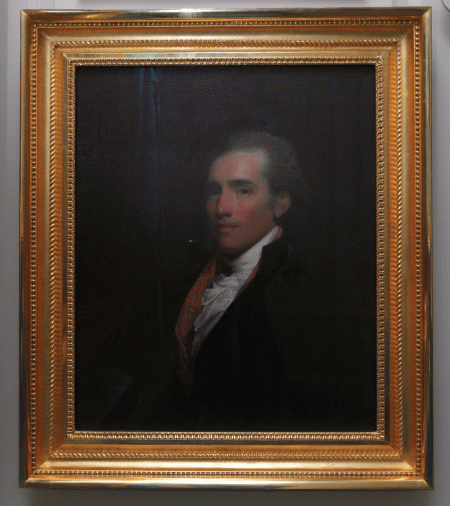
by Gilbert Stuart, c. 1797
Original oil-on-canvas and reproduction frame
This handsome portrait of Englishman Thomas Police force was produced in the late 1790s by Gilbert Stuart, the preeminent artist of the period in America. Information technology may accept been painted in 1796, the twelvemonth Thomas Constabulary married Elizabeth (Eliza or Betsy) Parke Custis, the eldest granddaughter of Martha Washington. The Laws presently had a daughter, Eliza Parke Custis Law, only differences in temperament led to their separation. Police force returned to England betwixt 1802 and 1804, the couple legally separated in 1804, and they divorced in 1811. In this painting, Law is shown in a prominently visible pink "underwaistcoat,'" a garment that had recently come into fashion. Though there is no record of the Washingtons acquiring the painting, it was likely a gift from Thomas Law. The painting appears on both George and Martha Washington'due south probate inventories.
Frame: Thomas Police likely had this portrait framed in Philadelphia in preparation for presenting it to George and Martha Washington. The painting is the most valuable listed in the Front Parlor at $80, and the quality and ornamentation of the frame likely contributed to its expense. This frame is a replica based on an original found on a Gilbert Stuart portrait of George Washington painted in 1795. The beading, lamb's natural language molding, and spiral decorations all added to the piece's expense. P. H. Miller Studios of Berryville, Virginia reproduced this frame with drawings done by Steven W. Spandle, Builder and the gracious permission of Christie'due south, Inc. Ann Creager and Alexandra Tice of Maryland and Washington, D.C. conducted the painting conservation.
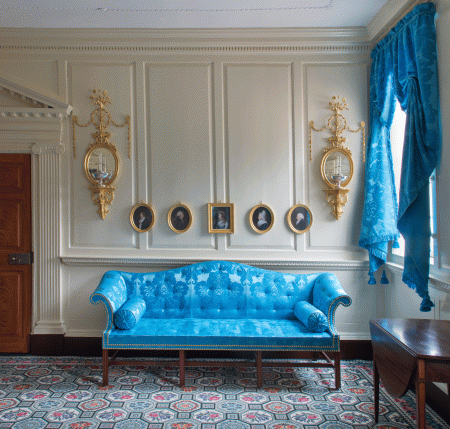
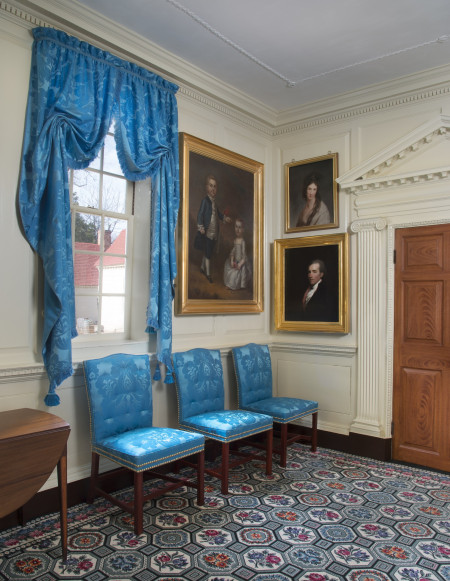
Seating Furniture
Gavin Asworth
Gavin Ashworth
Recreation, 2017-2019
In 1774, Washington received a new suite of parlor furniture as a gift from his friend and neighbour, George William Fairfax. This suite consisted of a set of 8 backstools, chairs upholstered on the dorsum and the seat, and a sofa all upholstered in luxurious blue silk and worsted damask. While none of this furniture survives today, there is articulate documentation of the appearance of the furniture, its travel from a London upholsterer to the blue dressing chamber at Belvoir Plantation, and finally to the front parlor at Mount Vernon.
The article of furniture is extensively described in George William Fairfax'south account book and besides in the inventory he took before departing Virginia in 1774. The chairs and sofa were all covered with "Superfe. Saxon Bluish Mix'd Damask," an expensive patterned textile made from silk and worsted fibers woven in a damask pattern. The defunction were fabricated from the same textile and lined with "fine Blew Tamy," or tammy, a plain woven, glazed wool textile that likely also covered the backs of the chairs and sofa. The color of the damask, Saxon blue, was a recently invented dye that was made with past mixing sulfuric acid and indigo. The result was a vibrant blue inclining towards dark-green. The color seems to take been highly durable and was used from its invention in 1749 through at to the lowest degree the end of the 18th century.
Recreation: Mount Vernon curators worked with upholstery experts in England and the United States to reconstruct the Fairfax/Washington suite of article of furniture. Adam Erby and Lucy Wood researched comparable examples of backstools and sofas surviving with original upholstery in English country houses. Kate Smith of Eaton Hill Weavers of Marshfield, Vermont used 18th-century dye recipes to perfect the Saxon blue color. Humphries Silk Weaving of Suffolk, England wove the silk and worsted wool damask using a damask pattern found on some other backstool. Leroy Graves of Williamsburg, Virginia made the sofa and backstools.
Source: https://www.mountvernon.org/the-estate-gardens/the-mansion/front-parlor/objects-in-the-room/
0 Response to "what happened to the spinning house after george washington died"
Post a Comment